Blossom: Social Investing
- 4.5
- Rating
- 100.00K
- Installs
- Free
- Price

 Analysis by App-foxy
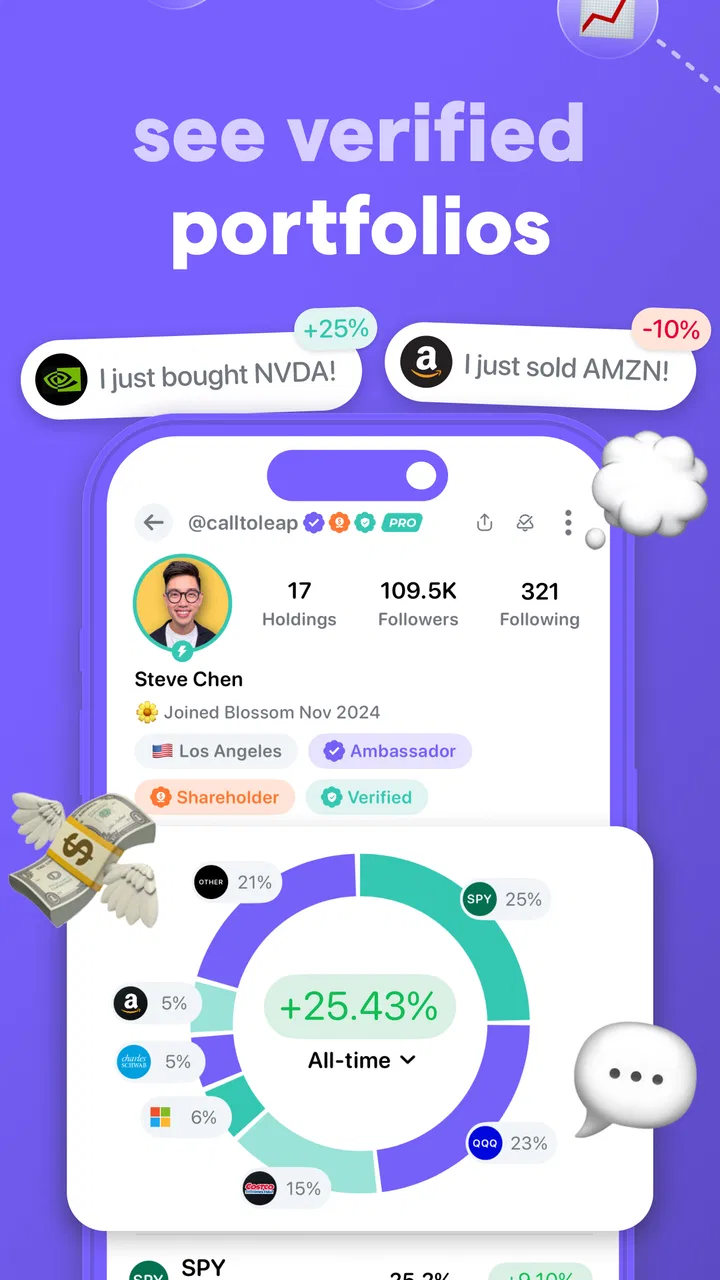
I approached Blossom: Social Investing as a finance app for people who want market research to feel less isolated. Its focus is not simply on watching prices. The experience brings together stock and ETF tracking, dividend awareness, and the ability to follow real investor portfolios. That combination makes it more social than a standard brokerage watchlist, while still keeping the main activity centered on learning and monitoring investments.
After spending time with it, my impression is that Blossom works best as a companion for deliberate investing rather than as a complete replacement for a broker. I can imagine opening it during a quiet evening, checking how a portfolio is positioned, comparing a few funds, and saving ideas to investigate later. I would not treat a social feed as a shortcut to financial advice, but I do see value in using other investors’ decisions as prompts for better questions.
How Blossom feels in its current form
The app comes from Blossom Social Inc. and sits in the finance category. It is free to install, with optional purchases ranging from $6.49 to $119.99 per item. The free entry point is useful because it lets a curious user understand the basic workflow before deciding whether extra features are worth paying for. I would still check exactly what each purchase unlocks before spending, especially if I only need a simple watchlist.
You May Also Like

 Blood Strike: 2.5 Anniversary
Blood Strike’s Loadouts Turn Every Drop Into a Tactical Gamble
A close look at Blood Strike’s custom loadouts: how fast access to signature weapons reshapes its battle royale rhythm, rewards preparation, and narrows the gap between fights.

 Pandora - Music & Podcasts
Pandora’s Music Is Easy to Start, but Harder to Recover
Pandora’s strength is its low-effort path from a seed to a station. Its weak spot is how much confidence it asks you to place in connection, setup, and quiet recovery.

 8 Ball Pool
 Is Built on Rivalries, Rematches, and Routine
A close look at the rivalries, rematches, shared routines, and unanswered safety questions that turn a quick pool match into a persistent mobile community.

 Samsung Music
’s Quiet Strength Is Playing What You Already Own
Its reach comes less from spectacle than from dependable access to a personal library. That simplicity is both the app’s strongest retention engine and its ceiling.

 AccuWeather: Weather Radar
AccuWeather Review: A Quick, Clear Forecast for Everyday Decisions
For everyday plans, the best forecast is the one you can understand quickly. AccuWeather makes rain timing, radar, and local conditions easy to act on, with a few trade-offs.

 Hill Climb Racing
Why Hill Climb Racing Still Turns Crashes Into One More Run
A tiny car, a bumpy hill and one more upgrade: Hill Climb Racing keeps resurfacing because its simple chaos makes every near-miss feel personal.
More From Our News Desk



Blossom has a 4.5 average from around 4.4 thousand ratings and has passed 100 thousand installs. Those figures suggest a meaningful user base without making the app feel like an all-purpose financial platform. The audience appears better suited to people who enjoy researching investments and observing how others build portfolios than to someone looking for an app that handles every banking, trading, tax, and retirement task in one place.
The Teen content rating also matters. Younger users may find the educational and observational side approachable, but investing still involves real financial risk. I would encourage anyone using the app to separate learning from acting: a portfolio that looks attractive in a social view may reflect a different time horizon, income situation, risk tolerance, or tax position than yours.
A useful starting point for portfolio-minded users
The strongest part of the concept is the connection between public market information and human context. A normal quote screen can show a symbol, a price movement, or a basic chart, but it rarely answers the question, “Why is this person holding it?” Following investor portfolios can add that missing layer. It gives me a way to notice themes, compare approaches, and identify companies or funds that deserve independent research.
That does not mean every portfolio is equally useful. I would pay attention to consistency rather than a single impressive holding. If someone repeatedly favors dividend-paying companies, their choices may help me understand an income-oriented approach. If another investor concentrates on broad ETFs, that may be more relevant to a long-term beginner than a collection of volatile individual stocks. The social element becomes valuable when I use it to study habits, not copy transactions.
For a first session, I would avoid following too many accounts. A small, carefully chosen group makes the feed easier to interpret and reduces the temptation to jump between unrelated ideas. I would also keep a separate note explaining why I followed each portfolio. That simple habit turns passive scrolling into a research process and makes it easier to unfollow accounts that no longer teach me anything.
Tracking stocks, ETFs, and dividend ideas
Blossom’s coverage of stocks and ETFs gives it a broader purpose than an app designed only around individual companies. ETFs are particularly important for users who want to compare diversified approaches with single-stock ideas. I like that the same environment can support both kinds of observation, because it encourages a more balanced question: is a particular company genuinely more interesting than a fund that spreads exposure across many holdings?
The dividend angle is another practical strength. Dividend investors often need to think beyond daily price changes, and a social portfolio can show how income-focused users organize their holdings. I would use that information as a starting point for checking payout sustainability, sector concentration, and the difference between a high yield and a healthy business. The app can help me notice an idea; it cannot replace the deeper work needed to judge it.
A helpful workflow is to divide observations into three groups: companies I want to understand, ETFs I might compare, and dividend names requiring further verification. This prevents every interesting symbol from becoming an immediate candidate for purchase. It also makes the app more useful for someone who invests gradually, since research can accumulate without forcing a decision every time the market moves.
What the recent version means for established users
The current version is 3.7.8, which gives existing users a clear reference point when checking whether their installation is up to date. The app was released on August 3, 2022, so it is no longer a brand-new experiment. That matters because a product with several years behind it can be judged more on the steadiness of its core experience than on novelty alone.
I see the version number as evidence of continued product evolution, but not as a promise that every part of the experience has been transformed. For an existing user, the practical approach is to update normally, revisit the portfolio and social sections, and check whether the navigation still supports the way they actually research. Small changes can affect routines even when the main idea remains the same.
New users should not assume that a later version automatically makes the app a full investment platform. The central identity remains social investing and portfolio observation. The update history may improve the experience over time, but it does not change the basic responsibility to verify information elsewhere before making a financial decision.
On an Android device, the minimum operating-system requirement is version 6.0. That makes the app accessible to many older devices, although a modern phone will generally provide a more comfortable experience for reading portfolio details and moving through several screens. I would avoid judging the app on a very old handset alone, because finance interfaces can feel cramped when text, charts, and controls compete for limited space.
A realistic everyday use case
Imagine I have twenty minutes after work and want to review my investing plan without opening a trading app. I could browse a few followed portfolios, notice that several investors hold the same ETF, and then compare that observation with the individual stocks appearing in other portfolios. Instead of buying anything, I would write down the repeated themes, check the fund’s holdings and costs through a separate trusted source, and return to Blossom later with more focused questions.
That routine shows where the app fits. It can make research more engaging and can expose me to approaches I would not have found through a personal watchlist. It is less suitable for urgent execution, detailed tax planning, or a complete household financial review. If I need to place an order, reconcile cash, or manage a retirement account, I would move to a regulated brokerage or dedicated financial service rather than expecting Blossom to do that job.
Where the social approach helps—and where it can mislead
Social investing has a built-in tension. Seeing real portfolios can make abstract financial ideas easier to understand, but it can also create a false sense of confidence. A visible holding does not reveal every reason behind it. I may not know when the position was opened, how large it is relative to the rest of the account, or whether it is part of a temporary experiment.
For that reason, I would treat portfolio following as a form of idea discovery. The best question is not “What should I buy?” but “What can I learn from this allocation?” That change in wording protects the useful part of the feature while reducing the risk of copying someone else’s risk. It is especially important with dividend portfolios, where an attractive distribution can distract from business quality or concentration.
Another trade-off is attention. A conventional watchlist is quiet until I choose to inspect it. A social investing app can encourage more frequent checking because there are always new ideas or portfolio movements to notice. If I am prone to reacting emotionally to market noise, I would set a schedule for using Blossom instead of opening it whenever prices move.
Who should use it and who should skip it
I would recommend Blossom to a beginner who wants a more concrete way to learn how investors think, to an ETF researcher comparing different portfolio styles, and to a dividend-focused user who enjoys studying income-oriented holdings. It can also suit an experienced investor who wants a second place for idea generation without confusing that activity with order execution.
I would be more cautious recommending it to someone who wants personalized financial advice. Following a portfolio is not the same as receiving guidance tailored to personal goals. I would also point elsewhere if the main requirement is direct trading, automatic budgeting, bank aggregation, detailed performance reporting, or tax documents. A brokerage app or a dedicated planning tool will usually be a better match for those tasks.
Users who dislike public or social aspects of finance may find the central concept unnecessary. If all I want is a private list of symbols and alerts, a traditional market-tracking tool may feel cleaner. Blossom earns its place when the human layer adds context; without that interest, its distinctive feature becomes less important.
Small habits that make the app more useful
My first tip is to separate discovery from verification. When a portfolio introduces me to a stock or ETF, I would save the idea mentally or in a private note, then inspect official fund documents, company filings, and independent research before forming an opinion. This two-step process prevents the social presentation from becoming the entire investment case.
My second tip is to compare concentration, not just names. Two investors may hold the same company, yet the position can represent a very different level of risk in each portfolio. The app is most informative when I look at the surrounding holdings and ask whether the same idea appears as a small supporting position or a dominant bet.
My third tip is to use dividend information as a prompt for quality checks. I would examine whether the income appears dependable, whether the portfolio is overly concentrated in one industry, and whether the overall approach matches my need for growth or income. A high distribution alone is not a reason to buy, and Blossom is better used to surface candidates than to settle that judgment.
Finally, I would review followed portfolios periodically. An account that was educational six months ago may no longer fit my goals, while a quieter portfolio may become more useful as my interests change. Curating the social side keeps the app from turning into an endless stream of disconnected investment suggestions.
Remaining gaps and practical friction
The biggest limitation is the risk of mistaking visibility for completeness. A portfolio view can be compelling, but it may not provide all the context needed to evaluate an investment. I would want to cross-check important details elsewhere rather than assuming that a clean presentation includes every factor that matters.
The free model is welcoming, but optional purchases introduce another decision before the app becomes part of a long-term routine. Since the available items span from $6.49 to $119.99, I would be especially careful about paying for advanced access before establishing a regular research habit. Someone who only checks a few ETFs occasionally may gain little from upgrading, while a committed user may find additional tools easier to justify.
There is also a psychological limitation that no interface can completely solve. Social feeds can encourage comparison, and comparison can turn investing into a performance contest. I would not use Blossom as a daily scoreboard. My own goals, time horizon, and ability to tolerate losses matter more than whether another investor’s portfolio looks more exciting.
Privacy and comfort are personal considerations too. Anyone uneasy about viewing or sharing investment activity should read the app’s current account and visibility choices carefully before building a public presence. The social premise is a benefit only when the user understands what they are comfortable revealing and how much attention they want from the community.
What I would watch as the product continues to evolve
For future use, I would watch how Blossom balances social discovery with responsible context. The most valuable direction would be clearer ways to understand why a portfolio is interesting without encouraging blind imitation. Better organization for research notes, stronger comparison workflows, and calm presentation of dividend information would all support thoughtful use, provided they remain easy to navigate.
I would also pay attention to how well the app serves both sides of its audience: newcomers who need explanation and experienced users who want efficient filtering. Too much simplicity can frustrate serious researchers, while too much density can overwhelm someone opening a finance app for the first time. The best evolution would preserve the approachable social idea while making it easier to distinguish education, observation, and action.
For existing users, the sensible expectation is gradual refinement rather than a sudden replacement for a brokerage. The current release shows a mature product direction, but the app’s usefulness still depends on how thoughtfully I use its information. I would keep it alongside my established financial tools, not in place of them.
My final view is positive but measured. Blossom: Social Investing gives market research a human dimension, and its mix of stocks, ETFs, dividends, and investor portfolios can make learning more concrete. I especially like it for building a shortlist of ideas and comparing investing styles. I would skip it if I wanted only private price tracking or direct trading, and I would never treat its social portfolios as personalized advice.
Used with a notebook, independent verification, and a clear investing plan, it can become a thoughtful research companion. The free starting point makes it easy to test, while the optional purchases mean I would only pay after understanding my own usage. In my experience, the app is at its best when it helps me ask better questions—not when it tries to give me an answer before I have done the work.
FAQs for Blossom: Social Investing
01What is Blossom: Social Investing, and how does it work?
Blossom: Social Investing is an investment-focused social platform that combines portfolio tracking, market information, and community interaction. After creating an account, users can explore investment ideas, follow other investors, discuss companies, and monitor their own holdings. The app is designed to make investing more collaborative, but the information shared by the community should be treated as research rather than personalized financial advice.
02Can beginners use Blossom: Social Investing comfortably?
Yes, beginners can use Blossom to learn how investors think, discover terminology, and follow discussions about stocks and portfolios. The social format can make financial topics easier to explore than traditional market apps, although some conversations may assume prior knowledge. New investors should take time to understand risk, diversification, fees, and the difference between educational content and a recommendation before making any investment decision.
03Does Blossom: Social Investing let me buy and sell stocks directly?
Blossom is primarily built around social investing, portfolio organization, and investment discovery, so users should not automatically assume that every feature supports direct trading. Depending on the current version, region, and connected services, the app may focus on tracking investments or linking users to external brokerage platforms. Check the app’s latest listing and account settings to confirm available trading integrations before downloading.
04Is Blossom: Social Investing free to download and use?
Blossom may be available to download without an upfront charge, but some features can depend on the app’s current subscription structure, premium tools, or account requirements. Availability and pricing may also vary between Android and iOS, as well as by country. Before committing, review the in-app purchase details, subscription terms, and cancellation information shown on the relevant app store.
05Is my financial information safe when using Blossom: Social Investing?
Users should review Blossom’s privacy policy and permissions before connecting brokerage accounts, importing portfolio data, or sharing personal information. Use a strong, unique password and enable any available security protections, while avoiding the publication of sensitive account details in public discussions. As with any financial application, download it only from an official store and verify how data is collected, stored, shared, and deleted.
Pros
- Clean interface makes portfolio tracking easy for beginners.
- Discover investment ideas through a social
- community-driven feed.
- Useful tools for comparing performance and monitoring watchlists.
- Supports learning by letting users follow experienced investors.
- Convenient access to market updates and investing discussions.
Cons
- Social posts may encourage emotional or impulsive investment decisions.
- Some features may require a paid subscription or in-app purchases.
- Investment information can vary in quality between community members.
- Not ideal for users seeking advanced trading or technical analysis tools.
- Availability of features and assets may differ by country or platform.

Blossom: Social Investing
Gallery